Having had Zigbee in the home for a couple of years, and getting more and more devices spread across the home, I figured it was time to understand a little more about the protocol, and also work toward my CWISA certification.
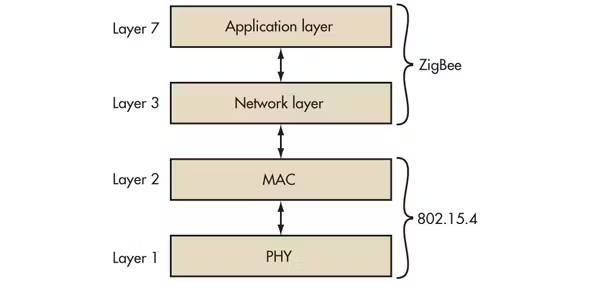
Zigbee is a wireless networking protocol that is primarily used for low-power, low-data rate applications in the Internet of Things (IoT). Zigbee falls under the IEEE 802.15.4 specification, which covers a suite of high-level communications protocols for creating personal area networks (PANs) via low-power digital radios.
One of the key features of Zigbee is its low power consumption, which makes it well-suited for use in battery-powered devices, such as temperature, door/window, or movement sensors. This is particularly useful in IoT applications, where devices may need to operate for long periods of time without access to a power source. Zigbee also has a relatively low cost and is easy to implement, which makes it a popular choice for IoT developers and home automation enthusiasts.
Another advantage of Zigbee is its mesh networking capabilities. In a mesh network, each device can act as a router, forwarding data to other devices in the network. This allows for increased reliability and coverage, as data can be transmitted over multiple hops if necessary. It also makes it easy to add new devices to the network, as they can simply join an existing network without the need for multiple hubs spread across the home, for example. Any wired, or permanently connected device (officially called Full Function Devices or FFDs), such as a power switch, whether integrated or added on to an existing power point, can act as a router within the network, thus extending the reach of the network for other non-permanently powered (i.e., battery) devices. These are also called Reduced Function Devices (RFDs), and as mentioned, can’t provide meshing. FFDs have their receivers continuously active, hence battery-powered devices are not suitable for this role, which allows them to provide meshing functions for other devices.
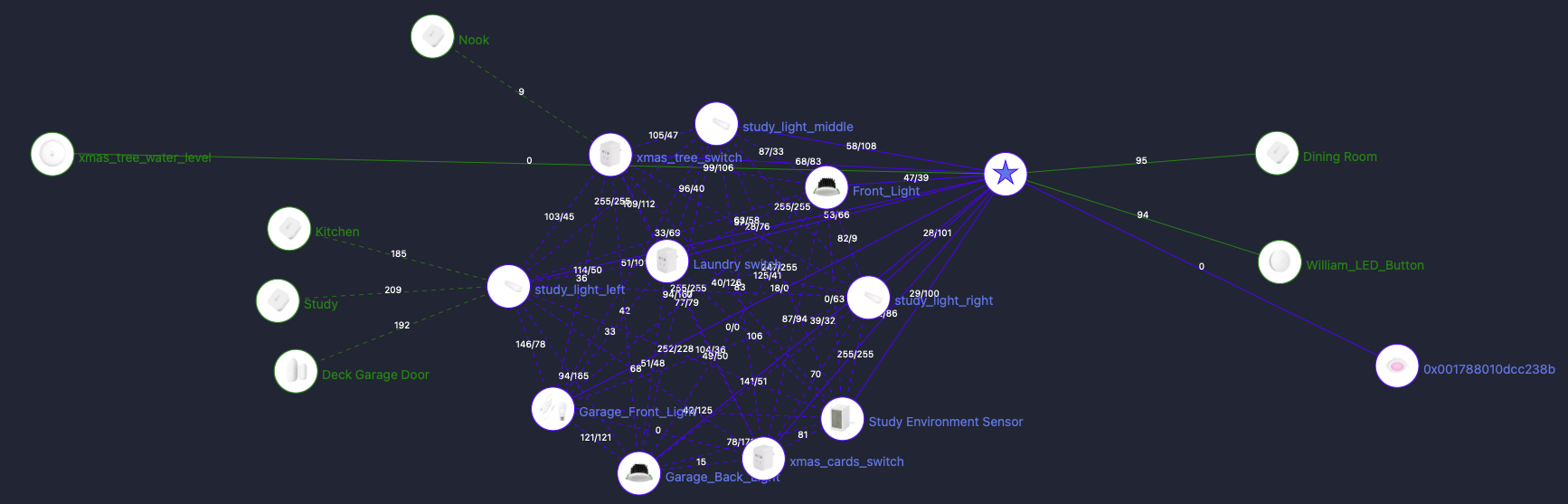
There are three classes of Zigbee devices: Coordinators, routers (as mentioned above, these are FFDs), and end devices (or RFDs). Each network requires a coordinator and can have as many routers as required in order to provide a strong network and/or extend the reach of the network, for example, from one end of the house to the other, or from house to garage. Coordinators are permanently powered devices and are typically USB sticks connected to a Raspberry Pi or NUC, in my case running Home Assistant. Through no particular deliberate effort, except for the far end of the house from where my coordinator sits, I’ve got a nice balance of FFD’s and RFD’s as you can see above.